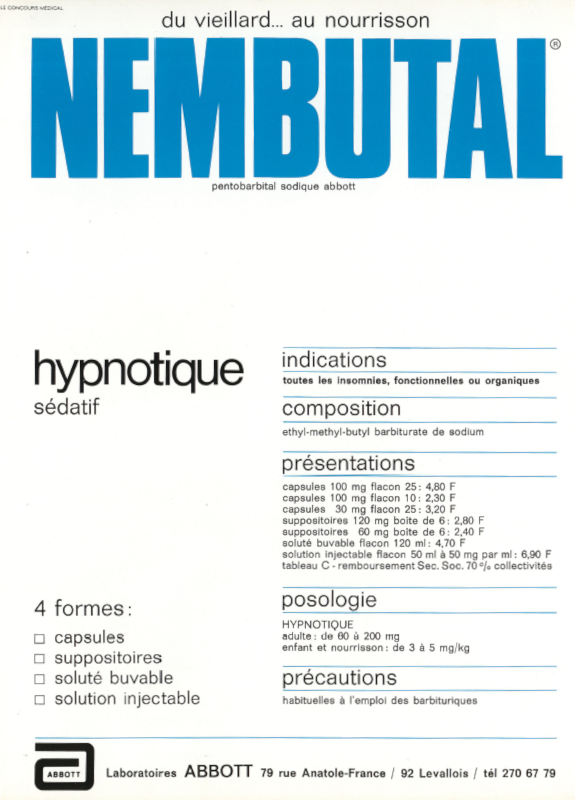
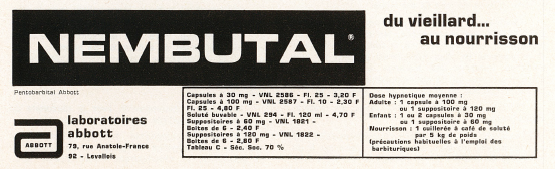
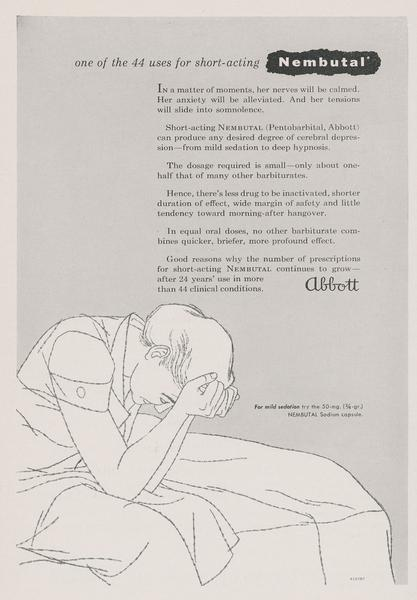
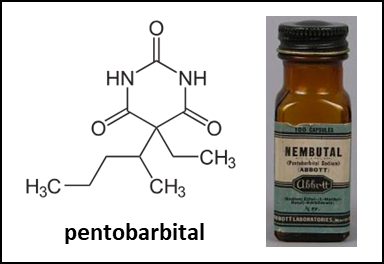
In the 1970s, the drug Nembutal was prescribed essentially for the treatment of insomnia. The drug was available in the form of capsules, suppositories, drinkable solution or as an injectable liquid. It was prescribed at all ages, from the infant to the elderly, as indicated on the advert. The drug was developed at Abbott Laboratories (US) in the 1930s. The name Nembutal derives from the chemical formula: Na (sodium) + embut (ethyl + methyl + butyl) + al (a common suffix for barbiturates). The drug active principle is pentobarbital which is a famous barbiturate used at that time for short-term treatment of insomnia (later replaced by benzodiazepines). Barbiturates are central nervous system depressant drugs which can be used sedative, preanesthetic, and to control convulsions in emergencies. But the drug pentobarbital is best known for its use for euthanasia for humans and animals.
Like other barbiturates, pentobarbital binds to the barbiturate-binding site on the GABAA receptor and activates the receptor. GABA (gamma-aminobutyric acid) is the principal inhibitory neurotransmitter in the brain. This agonist action increases the duration of ion-channel opening, thus causing a flow of small anions across the cell membrane, leading to cell death. In high doses, pentobarbital causes death by respiratory arrest. It is frequently used for veterinary euthanasia, and is used by some US states and the United States federal government for executions by lethal injection. In some countries and states, it is also used for physician-assisted suicide.
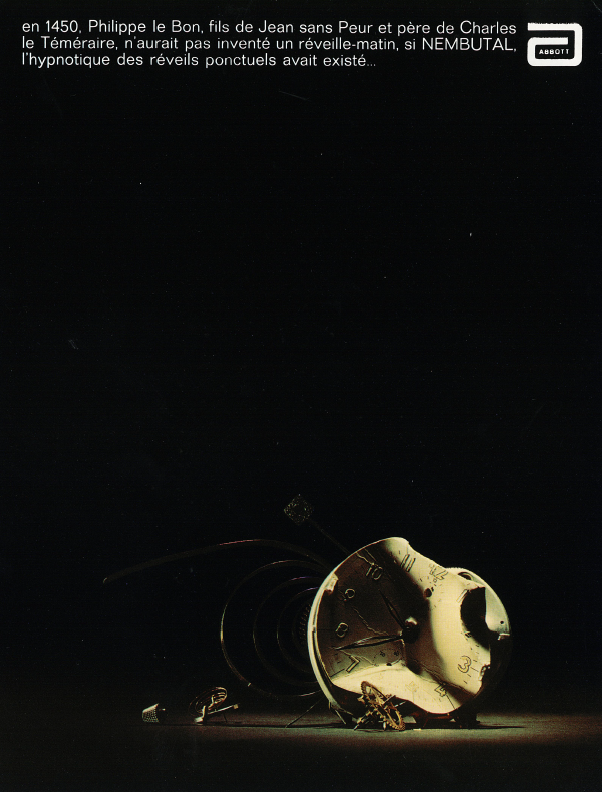
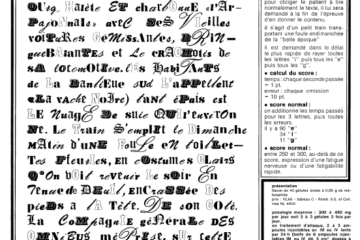
The drug advert for Nembutal (Abbott) says “in 1450, Philippe the Good (Duke of Burgundy), son of John the Fearless and father of Charles the Bold, wouldn’t have invented the alarm clock if Nembutal, the hypnotic for periodical wake-up had existed”. The story behind this advert showing a clock is not clear. It may derive from the Book of Hours, from Philip the Bold who reigned from 1419 to 1467. It was a religious book (Christian prayers) used to pray the canonical hours.